



Millennia-Old Stone Carvings Preserve the Legacy of Ancient Scholars, Overseas Chinese Media Explore the Cultural Heritage of Bazhong
稿件来源:菲律賓商報
2026年06月16日 20:33
Bazhong, Sichuan, June 11 (China News Service) — Standing in front of the cliffside of the Nankan Grottoes, representatives of overseas Chinese-language media raised their cameras one after another. Sunlight poured onto the thousand-year-old stone carvings, where the faint outlines of Buddha statues could still be seen and the flowing lines of their robes remained clearly defined。
When they reached the Flying Apsaras carvings, Xie Yan, president of Times Weekly (Canada), pointed his camera at the stone wall and carefully examined the details of the sculptures. “After listening to the explanation, I learned that Bazhong has 36 different styles of Flying Apsaras. From what I saw, each one really has a distinct design—truly exquisite,” Xie said。
On June 10, representatives of overseas Chinese-language media participating in the “2026 Overseas Chinese Media Sichuan–Chongqing Tour—Focusing on the Development of the Chengdu–Chongqing Economic Circle” visited Bazhou District in Bazhong City, Sichuan Province. Between the Nankan Grottoes and the Yan Yangchu Memorial Museum, they explored the city’s cultural heritage and historical memory。
The Nankan Grottoes were first constructed during the Sui Dynasty and flourished in the Tang and Song dynasties. They are one of Sichuan’s important surviving grotto temple sites. Yang Luping, head of the Nankan Grottoes interpretation team, introduced that more than 1,000 statues remain, distributed layer by layer along the cliffside according to the terrain. Compared with grotto complexes such as Dunhuang and Longmen, the Nankan Grottoes preserve more of the regional characteristics of Bashu stone carving art, making them important physical evidence for studying the spread of Buddhism and the development of grotto art in southwest China。
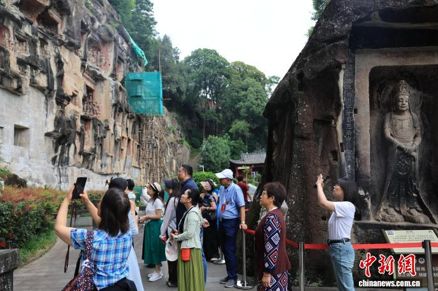
On June 10, representatives of overseas Chinese-language media participating in the “2026 Overseas Chinese Media Sichuan–Chongqing Tour—Focusing on the Development of the Chengdu–Chongqing Economic Circle” joint visit toured the Nankan Grottoes in Bazhou District, Bazhong City, Sichuan Province. Photo by reporter Zhang Lang
“I have visited many grotto sites before, including the Kizil Caves in Xinjiang, the Mogao Caves in Dunhuang, and the Longmen Grottoes. Many overseas audiences are familiar with Dunhuang, but not necessarily with the Bashu grottoes,” said Zhu Xinue, deputy editor-in-chief of China Weekly (Egypt). She noted that the Nankan Grottoes revealed a more diverse side of China’s grotto culture. “The existence of similar grottoes in Sichuan and northern China shows that exchanges between these regions were very close at that time. These carvings are beautiful and also bear witness to the cultural exchanges along the ancient Shu Road,” she said。
Inside the Yan Yangchu Memorial Museum, yellowed photographs, precious manuscripts, and historical documents record the extraordinary life of this Chinese educator. Born in Bazhong, Yan Yangchu devoted his life to mass education and rural reconstruction and is known as the “Father of Mass Education。” His educational philosophy and rural development practices influenced many countries and regions and continue to have wide international impact。
For many overseas Chinese media representatives, Yan Yangchu is not an unfamiliar name. In Southeast Asia and North America in particular, his educational ideas are still studied and discussed today. “Yan Yangchu lived in the Philippines for many years and helped many rural communities. There is even a memorial museum dedicated to him there. Even today, the local Chinese community still lays flowers at his memorial every year,” said Cai Youming, editor-in-chief of the Philippine Commercial News. He noted that Yan has significant influence in the Philippines and is widely known among older generations。
From the Nankan Grottoes to the Yan Yangchu Memorial Museum—one preserves millennia of civilization, the other bears witness to modern exploration; one reflects the historical depth of Chinese culture, the other demonstrates the social responsibility of Chinese intellectuals. In recent years, Bazhong has continuously advanced the protection and utilization of its historical and cultural resources through cultural exhibitions, study tours, and digital communication, enabling more people to learn about its heritage。
For the overseas Chinese media representatives, this visit was not only a cultural experience but also a window into observing China’s historical and contemporary development. At the end of the trip, Cai Youming remarked: “Here we not only see stone carving art, but also a Chinese thinker who influenced the world. Such cultural stories deserve to be shared with more overseas audiences。”