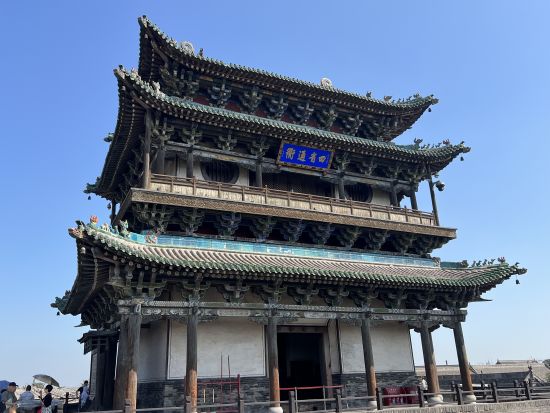




"Ah! How perilous and towering it is! The road to Shu is harder than climbing to the heaven!"
稿件来源:菲律賓商報
2026年06月10日 23:28
More than a thousand years ago, Tang Dynasty poet Li Bai penned The Hard Road to Shu, a masterpiece that continues to be recited today. A millennium later, representatives of overseas Chinese-language media retraced this historic route linking China's Central Plains and the Bashu region, standing among steep cliffs, imposing mountain passes and winding ancient roads。
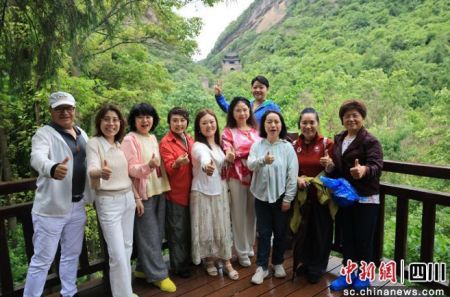
Representatives of overseas Chinese-language media visit Jianmen Pass. Photo by Zhang Lang
On June 7, participants in the “2026 Overseas Chinese Media Tour of Sichuan and Chongqing — Focusing on the Chengdu-Chongqing Twin-City Economic Circle”, visited Jianmen Pass Scenic Area in Guangyuan, Sichuan Province。
Standing before the towering cliffs and overlooking the rugged mountains, Sun Yumei, vice president of Romania's European Chinese Newspaper, expressed her admiration. "I had learned about Jianmen Pass before, but I never imagined it would be so majestic and magnificent," she said。
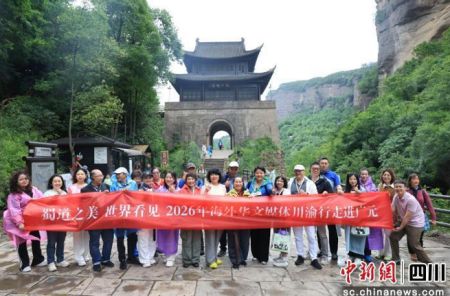
Representatives of overseas Chinese-language media visit Jianmen Pass. Photo by Zhang Lang
"The peaks of Jiange rise lofty and steep; one man guarding the pass can hold back ten thousand." Yang Xue, an employee of Jianmen Pass Tourism Development Co., Ltd., explained that Jianmen Pass was a strategic stronghold along the ancient Jinniu Road, one of the major routes of the Ancient Shu Roads. Known as "the most perilous pass under heaven," "the No. 1 pass under heaven," and "the gateway to Shu," it once served as a vital corridor for economic and cultural exchanges between China's Central Plains and the southwest。
Owing to its unique geographical position, Jianmen Pass also became a battleground of strategic importance throughout history. Speaking about cultural preservation efforts, Yang said that protection of historical relics has been continuously strengthened in recent years. "Our goal today is to preserve the ancient relics and ancient trees here and pass this precious heritage on intact to future generations," she said。
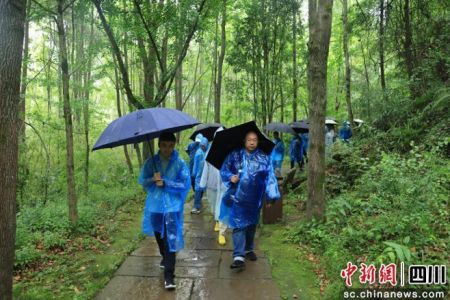
Representatives of overseas Chinese-language media visit Jianmen Pass. Photo by Zhang Lang
During a promotional session on the Jianmen Ancient Shu Road, Wang Shiwei, a member of the Party Working Committee and deputy director of the Administrative Committee of the Jianmen Shu Road Scenic Area, introduced the site as one of China's first national-level scenic areas。
The surviving remains are centered on the Jinniu Road section within Guangyuan and integrate Shu Road culture, Three Kingdoms culture and ecological culture。
Along the route are a series of renowned cultural landmarks, including Zhaohua Ancient City, known as "the first county of Bashu and the second capital of the Shu Kingdom"; Cuiyun Corridor, famous for its thousand-year-old cypress trees; and Jianmen Pass, immortalized by Li Bai's line that "the road to Shu is harder than climbing to the heaven." Together, these sites connect ancient passes, roads, trees and cities into a continuous cultural landscape。
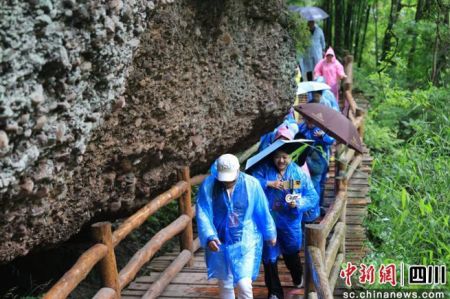
Representatives of overseas Chinese-language media visit Jianmen Pass. Photo by Zhang Lang
In recent years, local authorities have introduced a range of cultural and tourism products, including hiking routes along the Ancient Shu Roads, a unified admission pass for Jianmen Shu Road attractions, and immersive performances such as Romance of the Three Kingdoms Reimagined and Jiameng Spring and Autumn, enriching visitor experiences and breathing new vitality into the millennia-old route。
The value of the Jianmen Shu Road lies not only in its dramatic terrain, but also in its historical functions as a transportation corridor, military route, trade artery and channel for cultural exchange. Over centuries, the Jinniu Road connected China's Central Plains with Sichuan's fertile basin, facilitating the movement of people, goods and information between different regions。
Ancient passes, roads, trees, post stations and cities scattered along the route together form a historical corridor that can be walked, read and experienced。
As they climbed the mountain paths, overseas Chinese-language media representatives frequently stopped to photograph the Jianmen Pass gate tower, cliffside plank roads and sweeping mountain ridges。
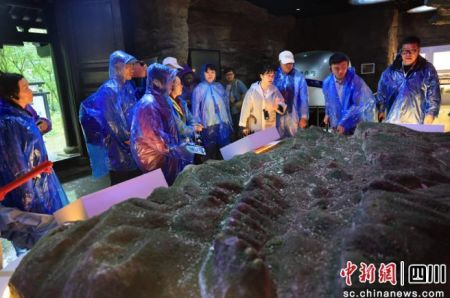
Representatives of overseas Chinese-language media visit Jianmen Pass. Photo by Zhang Lang
Unlike a purely natural landscape, Jianmen Pass seems to tell its own story. Between the cliffs stand strategic fortifications; along the mountain roads travelers from past and present come and go。
For many overseas Chinese-language media representatives visiting for the first time, Li Bai's famous description of the road being "harder than climbing to the heaven" became vividly tangible beneath their feet and before their eyes。
"In ancient times, without today's technology, carving a road through such steep mountains was almost unimaginable," said Li Mao-e, editor-in-chief of South Korea's World Overseas Chinese News. "The wisdom of the ancient people and the effort they devoted to this undertaking are beyond imagination. I was just telling my friends that this is truly an ancient Chinese transportation miracle."